
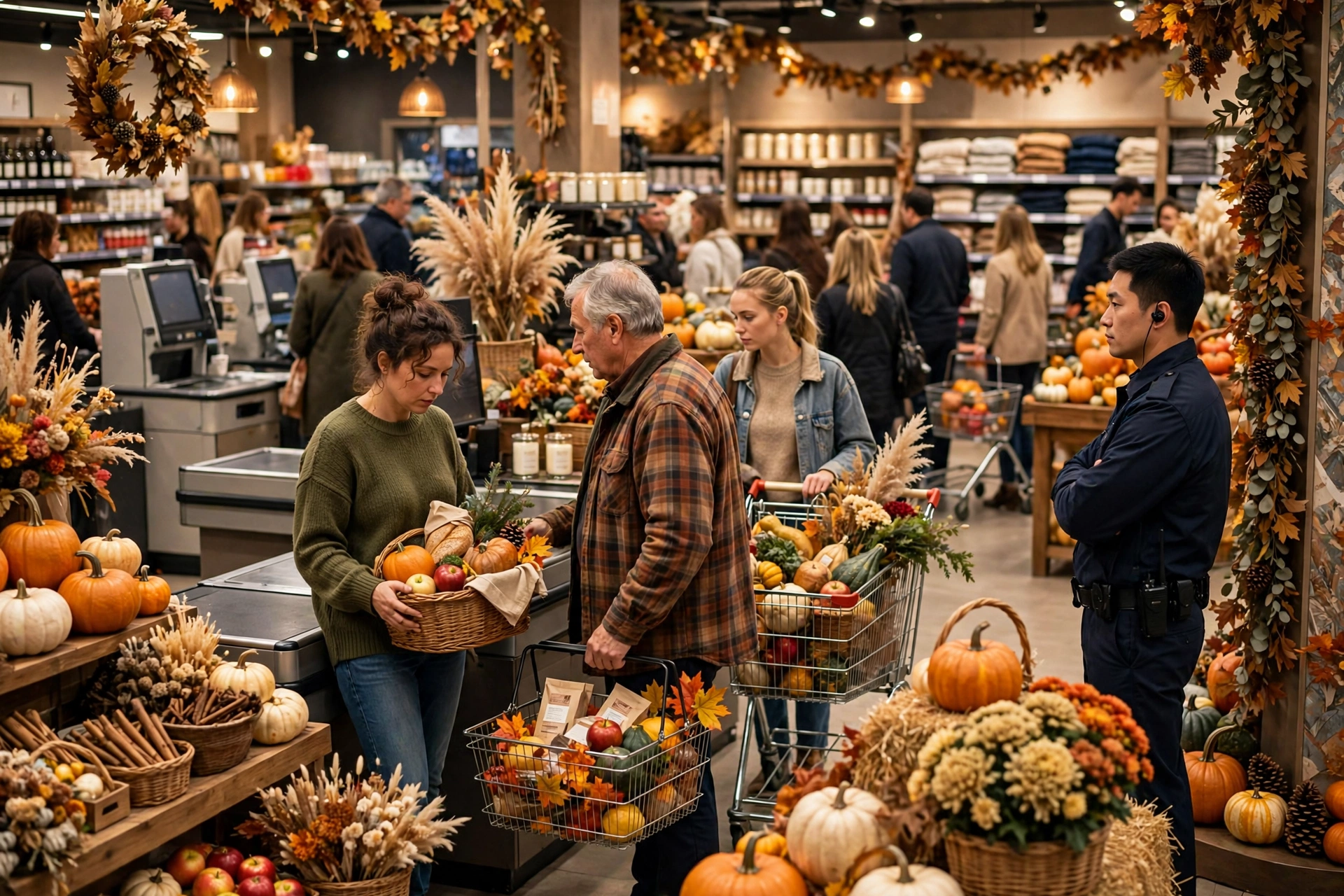
Partial-payment theft led the spike. What LP teams should carry into the holiday season.
Halloween fell on a Saturday this year, and offenders noticed. According to new data from retail intelligence firm SAI, reported by The Grocer on November 3, 2026, shoplifting offences soared 163% on Halloween compared with the year before. Theft peaked between 11 a.m. and noon, and London accounted for 61% of the hotspot activity, followed by the South East at 18% and the South West at 10%.
The figures come from more than 30,000 cameras across 1,000 UK supermarkets and convenience stores. The geography is British, but the pattern travels: a seasonal trading peak, crowded stores, stretched staff, and offenders working inside otherwise ordinary transactions. U.S. teams heading into Black Friday should read this as a preview, not a foreign curiosity.
What actually happened
The most common Halloween method was not the smash-and-grab. It was partial payment — a customer paying for part of a basket while intentionally leaving other items unpaid. That accounted for 62% of incidents, followed by grab-and-go at 38%. Shoplifting was also up 8% week-on-week, and SAI attributes part of the year-on-year jump to Halloween landing on a Saturday, traditionally one of the highest-risk days for retail loss, versus a Friday last year.
Context matters too. An estimated 78% of families celebrated Halloween this year, with consumer spending expected to rise 6% year-on-year to £705 million, according to SAI. Bigger crowds mean more cover, more transactions to monitor, and more chances for a partial basket to slip through unnoticed.
Why partial payment is the trend to watch
SAI’s UK head, Clare Hoole, put it plainly: theft is evolving, and many incidents now occur within otherwise legitimate transactions, making them harder to catch through traditional methods or passive surveillance alone. A partial-payment theft does not look like a theft at the door. It looks like a normal shopper who paid — for something.
That is exactly why it deserves attention in loss prevention planning. Self-checkout and busy staffed lanes both create the same opening: an item left in the trolley, a basket scanned selectively, a high-value product never presented. If your exception reporting only flags voids, no-sales, and refunds, you are missing the quietest form of shrink on the shop floor.
What to do before Black Friday
First, staff the peak, not just the day. Halloween’s 11 a.m. to noon peak is a reminder that theft concentrates in narrow windows. Map your own peak hours from the last two holiday seasons and make sure floor coverage and checkout supervision match them.
Second, audit partial baskets daily through the holiday period. Review self-checkout interventions, unmatched items, and transactions where the scanned total looks light against the basket visible on camera. Look for repeat patterns — the same person, the same product mix, the same lane — rather than treating each incident as a one-off.
Third, brief front-end teams on polite, specific intervention. Staff should know what to say when a basket does not match a receipt, and when to step back and let LP or a manager take over. A calm, factual challenge at the till prevents far more loss than a confrontation at the exit.
Fourth, use real-time visibility, not end-of-week reports. Hoole’s warning for the golden quarter is that theft pressure will stay elevated. Daily exception reviews, live camera checks during peaks, and same-day sharing of suspect descriptions across nearby stores turn a single incident into intelligence for the whole estate.
Finally, share the lesson across your stores now. Halloween data is most useful in the first week of November, while there is still time to adjust rotas, lane coverage, and audit routines before the Black Friday surge.
The bigger lesson
Seasonal peaks are no longer just busy days; they are targeted periods for heightened retail crime. Offenders plan around them the same way retailers do. The teams that come out of the golden quarter with shrink under control will not be the ones with the most cameras. They will be the ones that watched the transactions happening in front of those cameras, caught the partial basket early, and shared what they learned before the next peak arrived.
Source: SAI data reported by The Grocer, “Shoplifting offences soar 163% on Halloween,” November 3, 2026 — https://www.thegrocer.co.uk/news/shoplifting-offences-soar-163-on-halloween/725491.article
Halloween was the warning shot. The golden quarter is the test — make sure your team is watching the basket, not just the door.

Leave a Reply