
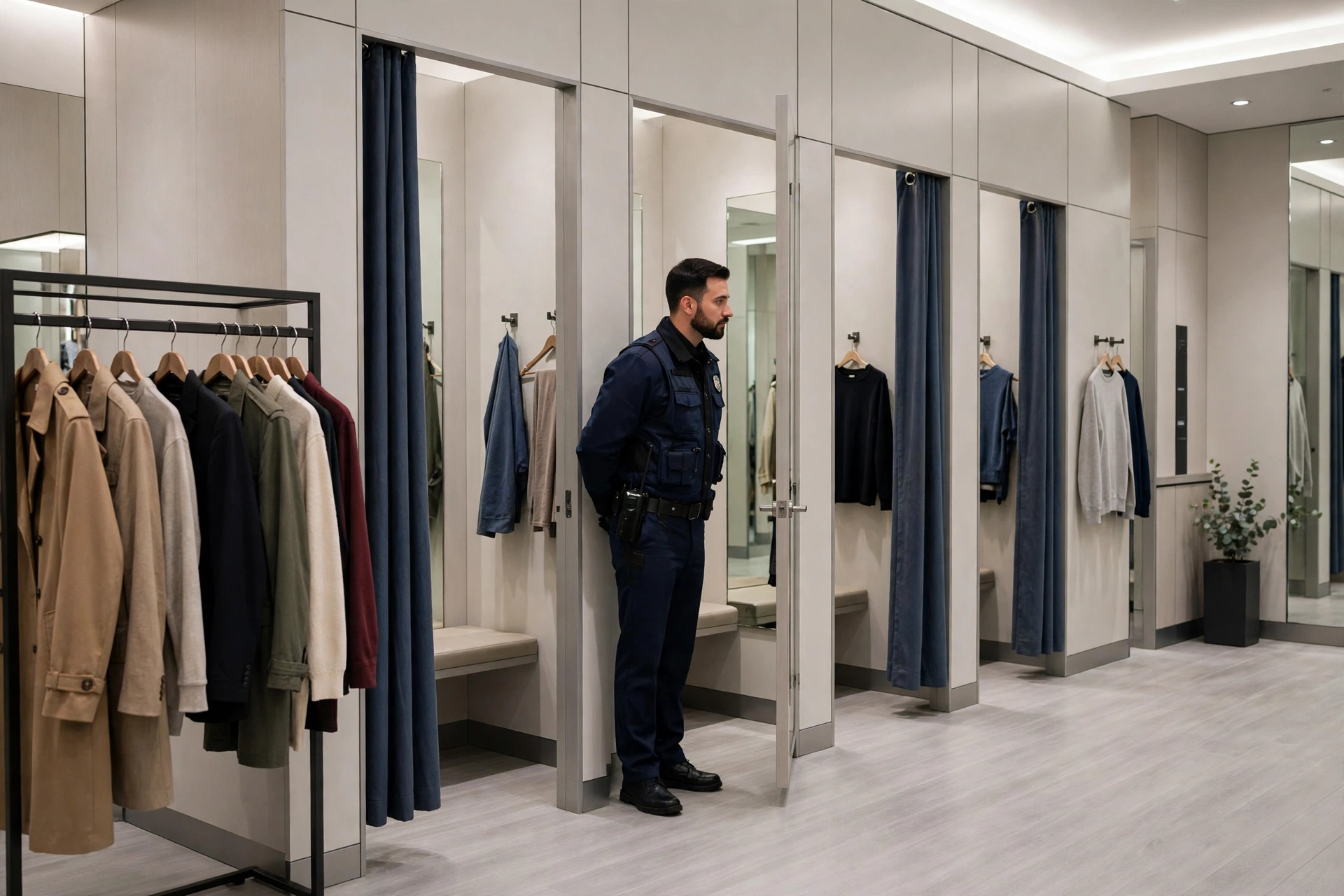
Concealment happens behind a closed curtain — so your controls have to work before the door closes.
Ask any experienced loss prevention agent where concealment happens most often in an apparel store, and the answer rarely changes: the fitting room. It is one of the few places in a store where a customer is legitimately alone, legitimately out of sight, and legitimately handling unpurchased merchandise. That combination makes it a natural target for concealment, tag removal, and wardrobing — and it means your controls have to work before the door closes, not after.
Here are five controls that actually work, without turning the fitting room into a confrontation zone.
1. Count in, count out — every time, no exceptions.
The single most effective fitting room control is also the simplest: count every garment going in and count every garment coming out. Use a numbered count card or a small tag handed to the customer at the entrance, and reconcile it at exit. When counts do not match, staff should know exactly what is missing — item, size, color — while the customer is still in the area. The control fails the moment it becomes optional during a rush. Peak hours are when it matters most, so staff the entrance during those windows rather than abandoning the count when the line grows.
2. Limit the number of items per visit.
A customer carrying twelve garments into a fitting room is harder to track than one carrying four. Set a reasonable per-visit limit — six is a common standard — and require the rest to be held at the entrance. This is not about inconveniencing honest shoppers; it is about keeping the count manageable and the reconciliation fast. Post the limit clearly at the entrance so it reads as store policy, not a personal judgment.
3. Design out the blind spots around the rooms, not inside them.
Never place cameras inside a fitting room — that is a privacy violation and a legal disaster. Instead, control what surrounds them: keep camera coverage on the entrance and exit corridor, keep sightlines from the sales floor open, and avoid layouts where a customer can slip from a fitting room into a stockroom door or an emergency exit unobserved. Remove extra hooks, shelves, and ledges inside stalls where tags and sensors can be hidden, and check that stall doors latch properly. A stall that will not close invites misuse; a stall with a hiding place invites concealment.
4. Check every room between uses.
A quick stall check after each customer is one of the highest-return habits in apparel LP. Staff should look for removed tags, detached sensors, empty hangers, and merchandise left behind — and log what they find, including the time and stall number. That log is more valuable than most teams realize: a pattern of tag removals in the same stall, on the same shift, or on the same weekday is early evidence of an organized effort, not a series of coincidences. A room that is never checked is a room where evidence disappears with the next customer.
5. Keep high-risk merchandise out of the fitting room loop.
Not every item belongs in a fitting room. Keep sensor tags and hard tags on garments until purchase, and consider keeping the highest-shrink items — premium denim, leather goods, and high-value activewear — in staff-assisted areas or behind the counter during peak theft periods. Train floor staff to offer help early and naturally: a greeting at the entrance, an offer to hold sizes, and a prompt count-out are customer service and loss prevention at the same time. When staff do find a discrepancy, the response should be calm, factual, and policy-based — “Our count shows one item unaccounted for; let me help you check” — never an accusation in front of other shoppers.
None of these controls requires new technology or a bigger budget. They require consistency: the same count, the same limit, the same stall check, on a slow Tuesday morning and on a packed Saturday afternoon. Fitting room shrink drops when the process is predictable — because the people testing it quickly learn that this store counts, checks, and notices.
Put the count card back at the entrance this week, and watch what your fitting room numbers do over the next thirty days.



Leave a Reply