
Tampered cards, barcode swaps, and bulk buys — the red flags your cashiers can catch before the money walks out.
Gift cards are easy money — for your customers and for fraudsters. A tampered card sells at full face value, leaves no inventory trail, and converts into cash or merchandise in minutes. LP teams that treat the gift card rack like ordinary merchandise are leaving a hole in the front end. Here is how to close it.
Watch for barcode swaps
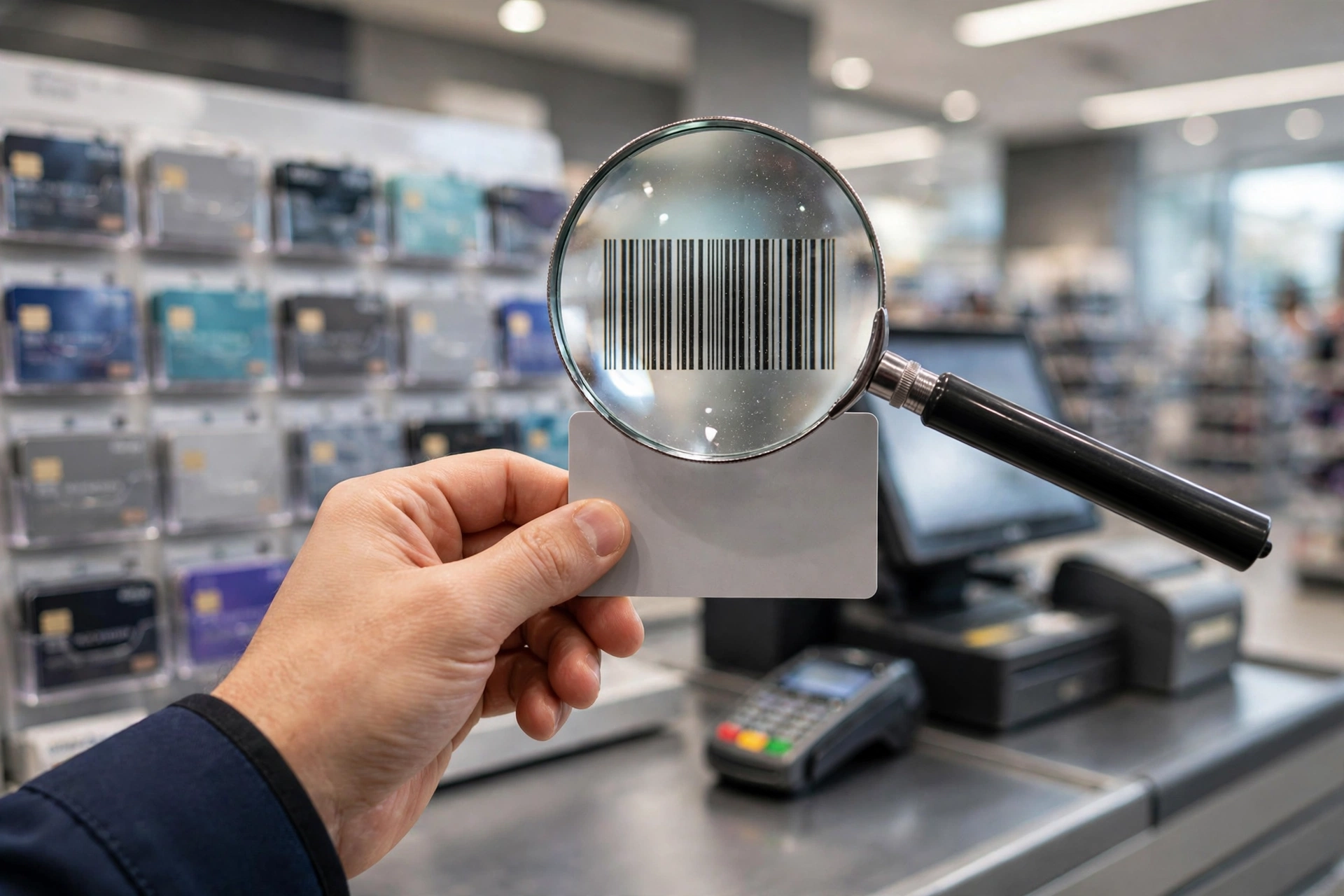
One of the most common schemes: a fraudster peels the real barcode off a card and replaces it with a barcode from a different card — one that stays in the fraudster’s wallet. At the register, the customer loads money onto the wrong card. Train cashiers to compare the barcode number with the number printed on the card itself, and to stop the sale if a sticker looks bubbled, re-glued, or even slightly off-center. A second set of eyes on an odd-looking card costs thirty seconds; a drained card costs hundreds.
Watch for tampered packaging
Scratch-off PIN panels that are already scratched, resealed blister packs, glue residue on the back of the card — all of it means the card data was likely copied before the card ever reached the register. The rule for front-end staff should be simple: pull any suspect card from the rack and hand it to LP. Do not sell it and “see what happens.” Log the card number so LP can check whether it was already drained, and share the pattern with peer stores.
Bulk buys at the register are a signal, not a coincidence
Legitimate customers rarely buy ten $500 cards in one transaction. Large-volume or sequential-denomination purchases — especially with cash — are a classic money-laundering and fraud pattern. Set a threshold (for example, any gift card transaction over $500, or multiple cards in one sale) that triggers a receipt review and a supervisor’s initials. Make sure your POS exception reports track gift card velocity by cashier, because internal involvement is a real part of this problem.
Secure the supply chain inside your own store
Unactivated cards sitting in an open display are bait. Keep high-denomination cards behind the counter or in locked cases, and run a weekly rack audit: count the cards, check packaging integrity, and confirm the rack matches what the system thinks is on it. Five minutes of audit time costs less than a single drained $500 card.
Gift card fraud is a process problem, not a people problem. Build the checks into the register routine, train your cashiers once, and audit the rack weekly — and the easiest money in your store stops walking out.


Leave a Reply